



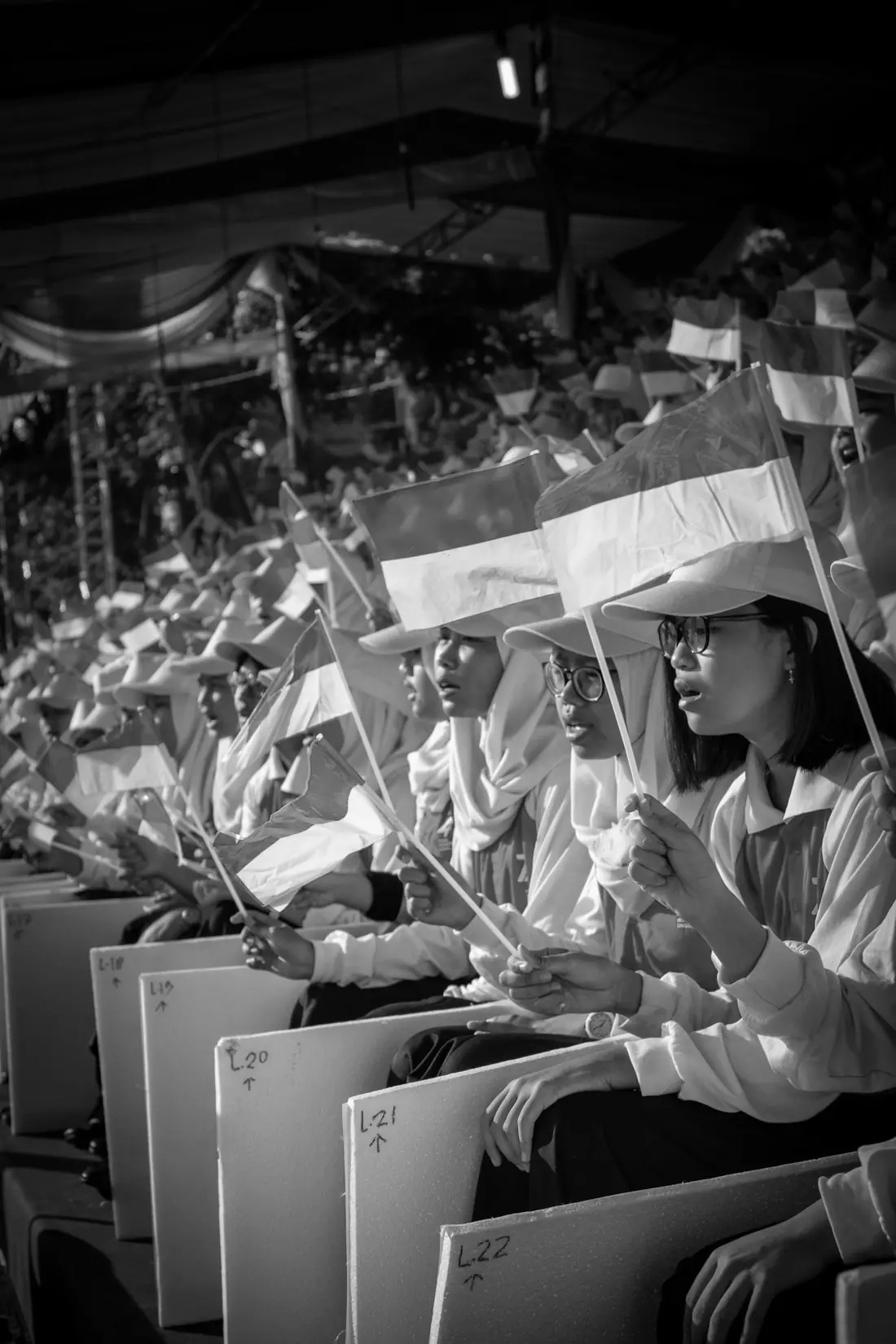

We believe politics is, at its heart, about change. Not change that falls from above, but change that begins with people who dare to think freely, speak honestly, and act for others. This is where we learn to do that. This is where we learn to free ourselves.
Idealisme adalah kemewahan terakhir yang hanya dimiliki oleh pemuda.
Idealism is the last luxury that belongs only to the young.
Our Story
In 2018, UIN Sunan Gunung Djati Bandung made a bold decision. Under its wider mandate, a university known for Islamic scholarship opened its doors to political science (Decree of the Director General of Islamic Education No. 283/KPT/I/2018). A handful of lecturers and a first cohort of students started with one conviction: an Islamic university should not watch politics from a distance. It should study it, question it, and help make it better.
Under the founding Head of Programme, Dr. H. Asep A. Sahid, M.Si. (2018 to 2023), the young programme grew quickly. Just three years after opening, it earned its first accreditation in 2021. In 2022 the curriculum was rebuilt from the ground up to keep pace with contemporary political science. Since 2023, Dr. Hasan Mustapa, S.Fil.I., M.Si. has led the next chapter.
Today that chapter has a name: Unggul (Excellent), the highest accreditation rating a study programme can earn in Indonesia. For a programme not yet ten years old, it is proof of what conviction, discipline, and a community of scholars and students can build together.
Beri aku 1.000 orang tua, niscaya akan kucabut Semeru dari akarnya. Beri aku 10 pemuda, niscaya akan kuguncangkan dunia.
Give me 1,000 old men and I will uproot Mount Semeru. Give me 10 young people and I will shake the world.
Faith That Moves Politics
Many people assume that religion and politics must be kept apart, or that one must swallow the other. We take a different path. In our classrooms, politics is grounded in iman and in the values of Islam. Power is an amanah, a trust that must be accounted for. Justice (ʿadl) is its measure, consultation (shūrā) is its method, and the public good (maṣlaḥa) is its purpose.
This integration is not a slogan. You study Fiqh Siyasah, Islamic Political Thought, and Islam and Democracy side by side with Western political theory, comparative politics, and public policy. In the same week you may read the ethical vision of the Qur’an and Montesquieu’s separation of powers, and ask what each of them demands of a just state today.
The compass for all of it is Rahmatan lil ʿĀlamīn: politics as mercy for all, not for one group alone. That is why our students learn to defend diversity as firmly as they hold their faith, for an Indonesia that belongs to every one of its citizens.
Tidak penting apa pun agama atau sukumu. Kalau kamu bisa melakukan sesuatu yang baik untuk semua orang, orang tidak pernah tanya apa agamamu.
It does not matter what your religion or ethnicity is. If you can do something good for all people, no one will ever ask what your religion is.
Vision, Mission and Objectives
Vision
To become an Excellent and Competitive Programme in Political Science in Southeast Asia, grounded in Rahmatan lil ʿĀlamīn, by 2029.
2029Mission
- To deliver education, research, and community engagement relevant to social dynamics at the local, national, and Southeast Asian levels.
- To prepare graduates with mental, spiritual, and intellectual resilience in the field of political science.
- To develop innovation and adaptation to advances in science and technology in order to enhance the self-reliance of graduates.
Objectives
- The delivery of education, research, and community engagement that responds to socio-political challenges at various levels.
- The formation of political science graduates who are academically, spiritually, and morally resilient.
- The creation of graduates capable of empowering society towards a democratic and just order.
Who You Will Become
Every graduate leaves with the same strong foundation and one sharpened direction. Here is exactly how the four years unfold, and where each path can take you after graduation.
Your Four-Year Journey
-
Year 1
Foundations
You learn how the Indonesian state works and the ideas behind it: Introduction to Political Science, the Indonesian Political System, Political Theory, and Introduction to Sociology, alongside Pancasila, Arabic, English, and the Islamic sciences.
By the end: you can explain who holds power in Indonesia, how they got it, and the values that should guide it. You join HIMAPOL and start finding your voice.
-
Year 2
Tools of analysis
You add the great traditions of thought (Political Philosophy and Ethics, Islamic, Indonesian, and Sundanese Political Thought, Fiqh Siyasah) and the tools to test them: Social Research Methods and Introduction to Social Statistics. You meet elections and parties up close.
By the end: you can read data, argue with theory, and you begin to see which of the four paths excites you most.
-
Year 3
Sharpen your path
You go deep: Qualitative and Quantitative Political Research Methods, Public Policy Analysis, Political Communication, Political Marketing, Political Technology and Innovation, and electives in your chosen direction. You join research in the Political Laboratorium and write for Candidate.
By the end: you have real projects in your portfolio and lecturers who know your work.
-
Year 4
Into the field
You test yourself in the real world through the Political Internship and the Community Service Programme (KKN), design your research proposal, pass the Comprehensive Examination, and write an undergraduate thesis in your path.
By the end: you graduate with a thesis, field experience, and a network that opens the first doors of your career.
Four Paths, One Purpose
Your first two years give you the foundations of all four paths, so you do not have to decide on day one. Choose your direction as you discover what moves you.
The Political Researcher
You ask the questions others avoid, and answer them with evidence.
You design studies on elections, religion and politics, local government, or democracy in the digital age. You collect data in the field, analyse it with rigour, and publish findings that move public debate from opinion to facts.
Skills you build
- Research design and fieldwork
- Interviews and qualitative analysis
- Survey design and social statistics
- Academic writing and presenting findings
Courses that get you there
- Political Theory
- Qualitative Political Research Methods
- Quantitative Political Research Methods
- Introduction to Social Statistics
- Academic Writing and Presentation
- Political Research Proposal Design
Your path, step by step
- Year 2
Assist a lecturer's project in the Political Laboratorium and learn how real research is done.
- Year 3
Present your first paper at a student forum and submit it to Candidate, our student journal.
- Year 4
Write a thesis on original data and intern at a research institute or survey organisation.
- After graduation
Start as a research assistant or analyst, or continue to a master's degree with an LPDP or Ministry of Religious Affairs scholarship, on the road to becoming a lecturer or senior researcher.
Where you could work
- Universities
- Research institutes and think tanks
- Survey and polling organisations
- Government research units
- Civil society organisations
The Public Policy Analyst
You turn data, budgets, and regulations into policy that serves people.
You study how decisions are made inside government, evaluate whether programmes actually work, and write clear recommendations for the people in charge. From village funds to national regulations, you make policy smarter and fairer.
Skills you build
- Policy analysis and evaluation
- Reading budgets and regulations
- Writing policy briefs
- Data analysis for decision making
Courses that get you there
- Introduction to Public Policy
- Public Policy Analysis
- Bureaucracy and Politics
- Introduction to Public Administration
- Indonesian Legal System
- Politics of Budgeting
- Local Democracy and Regional Autonomy
- E-Governance
Your path, step by step
- Year 2
Pick a local policy problem (waste, village funds, public services) and follow it through the semester.
- Year 3
Write your first policy brief and join the Centre for Global Affairs and Public Policy in the Political Laboratorium.
- Year 4
Intern at a local government office, regional parliament, or ministry, map village problems during KKN, and evaluate a real policy in your thesis.
- After graduation
Sit the civil service (ASN) selection, join a policy institute, or become expert staff to legislators.
Where you could work
- Ministries and local governments
- Legislatures, as expert staff
- Election management bodies
- Policy institutes and NGOs
- Development organisations
The Political Consultant
You design strategies grounded in research, not in guesswork.
You read voters, map stakeholders, and turn survey data into campaign strategy. You help candidates, parties, and organisations understand society and communicate with it, while guarding the integrity of the democratic process.
Skills you build
- Polling and public opinion research
- Electoral data analysis
- Political marketing and strategy
- Stakeholder and voter mapping
Courses that get you there
- Electoral Systems and Governance
- Political Parties and Party Systems
- Political Marketing
- Polling and Public Opinion
- Political Culture and Behaviour
- Techniques of Political Analysis
Your path, step by step
- Year 2
Analyse real election results and learn how electoral systems shape who wins.
- Year 3
Join a survey project, help organise campus elections, and lead programmes in HIMAPOL.
- Year 4
Intern at a consultancy, survey institute, or election body (KPU or Bawaslu), and write your thesis on voter behaviour.
- After graduation
Start as an analyst at a political consultancy or survey institute, join a campaign team, or work in election management.
Where you could work
- Political consultancies
- Survey institutes
- Campaign teams and political parties
- KPU and Bawaslu
- Government relations teams
The Political Communicator
You explain politics to the public with honesty and clarity.
You translate complex policy into stories people understand, through journalism, content, advocacy, and public relations. In an age of hoaxes and polarisation, you are the voice that informs rather than inflames.
Skills you build
- Political communication and framing
- Media and discourse analysis
- Writing and content production
- Public speaking and advocacy
Courses that get you there
- Political Communication
- Democracy and the Media
- Digital Democracy
- Political Technology and Innovation
- Academic Writing and Presentation
- English
Your path, step by step
- Year 2
Train in the Media Laboratory and write for HIMAPOL's channels.
- Year 3
Produce political literacy content and run a campaign on an issue you care about.
- Year 4
Intern at a newsroom or a public relations office, and write your thesis on media, discourse, or digital politics.
- After graduation
Work as a journalist, communications officer, digital campaigner, or spokesperson staff for an institution.
Where you could work
- Media and newsrooms
- Government public relations
- Parliamentary communication
- Advocacy NGOs
- Digital and creative agencies
Whichever path you choose, you graduate with the same promise: the knowledge to understand power, the values to use it well, and the courage to change things.
Alumni Already Changing Things
Our graduates did not wait for the future. They are already in the rooms where decisions are made. They guard the integrity of elections at the General Elections Commission (KPU) and the Election Supervisory Body (Bawaslu), right down to the polling station. They advise legislators as expert staff, serve the public as civil servants, and push for change from within civil society organisations.
Many have continued to master’s degrees in Indonesia and abroad, with scholarships from the Indonesia Endowment Fund for Education (LPDP), the Ministry of Religious Affairs, and other institutions. They now work as academics, researchers, and political consultants, speaking up on democracy, governance, and human rights.
Others have become political communicators and voices of their generation, shaping public opinion through the media, digital campaigns, and social movements. Together they represent a new generation of young Muslim intellectuals: critical, articulate, and principled in standing up for justice, diversity, and participation.
Learn, Research, Serve
We learn through lectures, debates, and project-based work that ties theory to the streets, the villages, and the halls of power. Our curriculum is built for the challenges of today, from the local level to Southeast Asia.
We research together. Lecturers and students work side by side through internal research schemes, external partnerships, and national and international forums, so that you learn to argue from data and critical analysis, not from opinion alone.
We serve through community programmes, training, policy advocacy, and political literacy work. For us these three pillars are not a formality. They are how character is built, and how this programme gives something real back to a participatory and democratic society.
Your Space to Grow
You will sharpen your communication and media analysis in the Language Laboratory and the Media Laboratory. You will find your voice and your network in active student organisations, where leadership is practised, not just taught.
Around you, the UIN Bandung campus offers a central library, a campus mosque, Wi-Fi across every area, a career services centre, a sports centre, and access to health and psychological services.
The story of this programme is still being written. The next chapter could be yours.